Workout guides For Time
What Does “For Time” Mean in a Workout?
A “For Time” workout gives you a fixed amount of work to finish as quickly as you can while meeting the movement standards. Your elapsed finishing time is your score. If there is a time cap, stop when that limit is reached.
- 00:00 · Start
- Work and rest as needed
- Finished · Stop the clock
The clock runs through your breaks. Stop earlier if you reach the time cap.
How does a For Time workout work?
Start the clock, complete the prescribed exercises, and stop it when the last required rep is done. The clock keeps running during rests and transitions. If a workout says “3 rounds for time,” you make three complete passes through the list, not as many passes as you can fit into a set duration.
The fixed amount of work could be several rounds, a single long exercise list, or a repetition sequence such as 21–15–9. With a two-movement 21–15–9 workout, you do 21 reps of each movement, then 15 of each, then 9 of each. Read the complete prescription before starting.
Speed is measured against the same task. Keep the assigned range of motion and technique rather than shortening the movements to get a faster time. If you change a load or exercise, record the change with your result.
An example: three rounds for time
Complete 3 rounds
- 10 bodyweight squats.
- 8 incline push-ups on a stable surface.
- 6 alternating reverse lunges in total.
Example time cap: 10 minutes. Choose versions and rep counts that suit you before you begin.
One round is all three exercises. Repeat the list three times, for a planned total of 30 squats, 24 push-ups, and 18 lunges. In this example, “6 alternating” means three per side, not six per side.
If you finish the last lunge at 7:42, your score is 7:42. You stop there instead of filling the remaining time with more rounds. The cap is an upper limit, not a requirement to exercise for ten minutes.
Warm up first and arrange your space so transitions are straightforward. Start at a pace that leaves you able to finish the later rounds. A very fast first set can cost time if it forces long breaks afterward.
What does a time cap mean?
A time cap limits how long the attempt lasts. If the workout is unfinished when the clock reaches the cap, stop and record your progress. Reaching 10:00 is not the same result as completing all the work in 10:00.
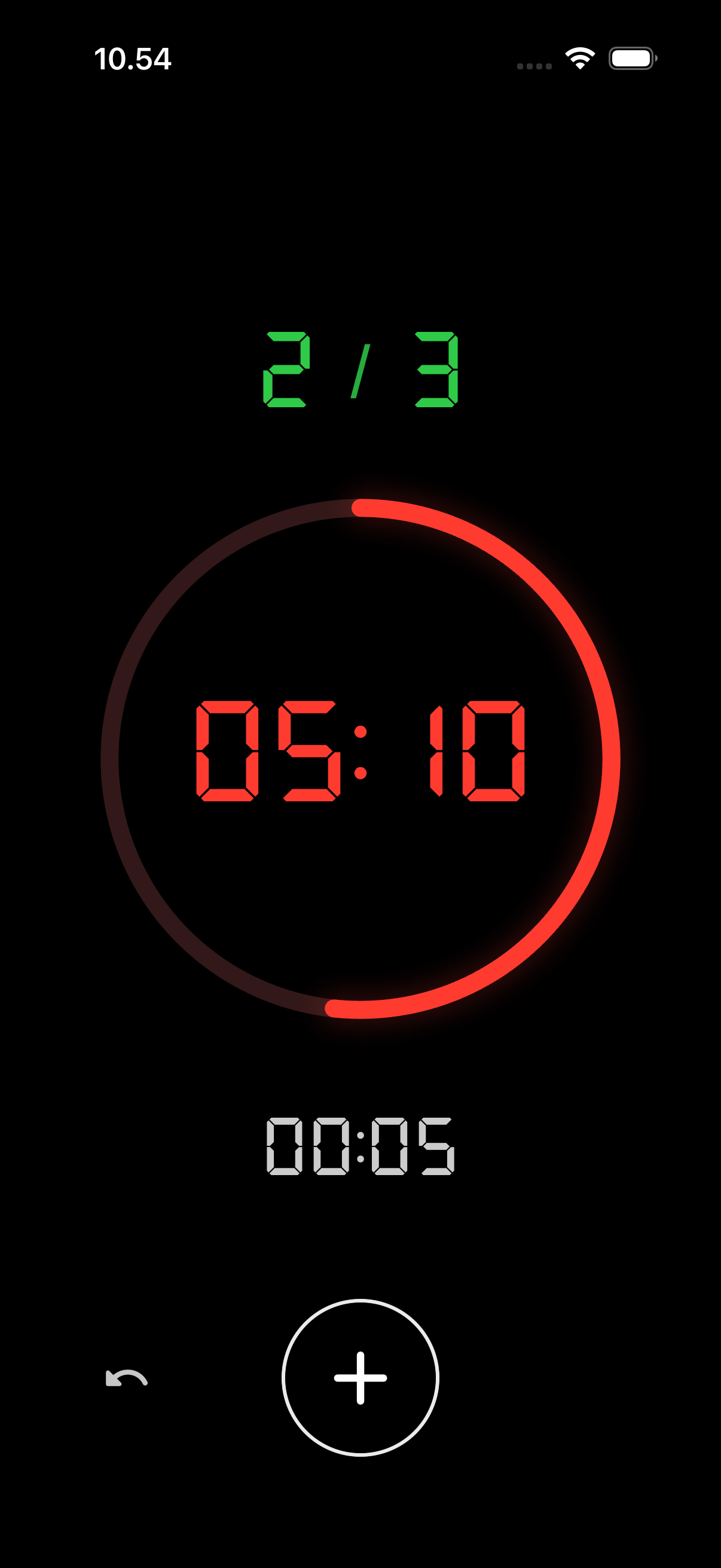
Suppose you finish two rounds of the example, then ten squats and four push-ups before the cap. Record time cap: 2 rounds + 14 reps. With 24 reps in each full round, that is 62 completed reps out of the planned 72.
Competition workouts may have specific rules for capped scores, tie-breaks, or partial distances. Follow that workout’s score sheet. For personal training, record enough detail to know what you finished and what you changed when you repeat it.
This is the key distinction from AMRAP: an AMRAP asks you to accumulate work for the full time window. A For Time workout asks you to finish its fixed task, with a cap as the limit if one is given.
A tie-break is an additional score defined by the workout. A no rep is an attempt that does not meet its movement standard.
How to time a For Time workout in Aika
Use Aika’s Count up timer so the display shows elapsed time. For a capped, repeated-round workout like this example, set the duration to 10:00, enable Track rounds, and set Target rounds to 3.
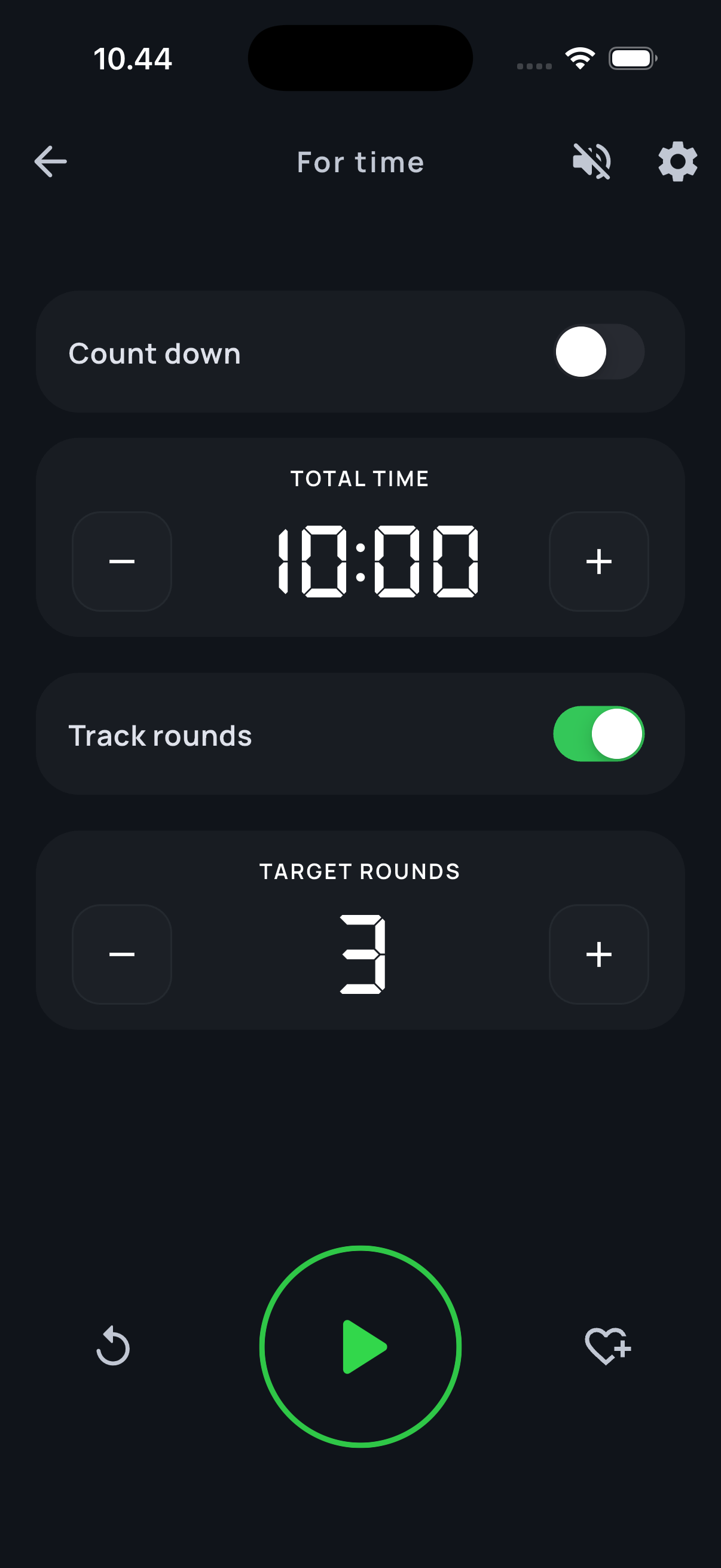
Tap + Round once after completing the last exercise of each round. Aika uses those manual taps to track progress and round times; it does not detect your repetitions. Completing the target rounds ends the attempt, while reaching the duration limit records a time-capped result.
Afterward, check the result and add notes or extra reps where needed. If your workout is one long exercise list rather than repeated rounds, make sure your tracking plan matches it; do not count every exercise as a complete circuit.
For a format that schedules each new set instead, read how EMOM workouts work. The EMOM vs AMRAP comparison explains the other common choices.
Common questions
What does “3 rounds for time” mean?
Complete the full exercise list three times, then stop. The clock runs continuously through all three rounds and any breaks; your score is the total elapsed time.
Can I rest in a For Time workout?
Yes. The clock continues while you rest. Manage your sets and breaks so that you can finish the prescribed work with consistent movement quality.
What if I reach the time cap?
Stop at the cap and record how much work you finished. A specific event or workout may define a reps-based score or a tie-break, so follow those instructions rather than treating the cap as your finishing time.
Is a lower score better?
For the same completed workout, standards, and load, a shorter finishing time is faster. If you change the exercise, range of motion, or weight, note the change so that future comparisons remain useful.
How is For Time different from AMRAP?
For Time ends when you finish the assigned work or reach the cap. AMRAP continues for its entire time window and measures how much work you complete. Read the AMRAP guide.