
Workout guides Tabata
What Is Tabata? The 20/10 Workout Explained
A Tabata-style timer alternates 20 seconds of work with 10 seconds of rest for eight rounds: four minutes including the final rest. The timing is simple, but using 20/10 intervals alone does not reproduce the intensity of the original Tabata research.
- 00:00 · Work
- 00:20 · Rest
- 00:30 · Next round
Repeat 8 times = 4:00, including the final 10-second rest.
The classic 20/10 structure
One Tabata-style block
- Work: 20 seconds.
- Rest: 10 seconds.
- Rounds: 8.
- Total: 4 minutes, including the final rest.
Start working at the first cue. At 20 seconds, stop and rest. At 30 seconds, begin the next interval. Each work/rest pair takes half a minute, so eight pairs take four minutes.
Unlike an EMOM, where you finish assigned reps and rest for the remainder, this timer fixes both parts. You work for the prescribed 20 seconds and then take the prescribed 10-second break. Finishing a chosen number of reps early does not automatically start the next interval.
The final work period runs from 3:30 to 3:50. Its ten-second rest brings the full block to 4:00. Preparation, warming up, and recovery between multiple blocks are extra time, so a four-minute block is not necessarily a four-minute training session.
The work/rest ratio for 20/10 is 2:1. This describes durations; HIIT also involves the intensity of the efforts.
The original protocol was more than a timer
The name comes from research by Izumi Tabata and colleagues. Their 1996 study used exhaustive cycling intervals: seven to eight 20-second efforts separated by ten-second rests, at an intensity of about 170% of VO₂max. See the original Tabata study abstract for the protocol and study conditions.
A bodyweight circuit that uses the same clock is therefore best described as Tabata-style intervals. Matching the work/rest ratio does not mean you matched the research intensity, participants, or training program, and it does not establish the same results.
That distinction helps you use the format honestly: borrow a clear timing pattern when it fits the session, without treating the acronym as a guarantee of a particular training effect.
Try the timing before chasing intensity
For a first practice with the clock, choose one familiar movement, such as comfortable stationary cycling. Warm up separately, then use the eight 20/10 intervals to learn the transitions at a manageable effort. This is a timing practice, not a recreation of the exhaustive study.
Repeating one movement avoids spending the short rest period moving equipment. If you use two movements, decide the sequence in advance: movement A in rounds 1, 3, 5, and 7; movement B in rounds 2, 4, 6, and 8. You still set eight rounds, not four.
If you need more than ten seconds to recover or get into position, change the workout to a custom interval with longer rest. Keep the description accurate when you do: 20 seconds on and 40 seconds off is a useful timing choice, but it is not the standard 20/10 pattern.
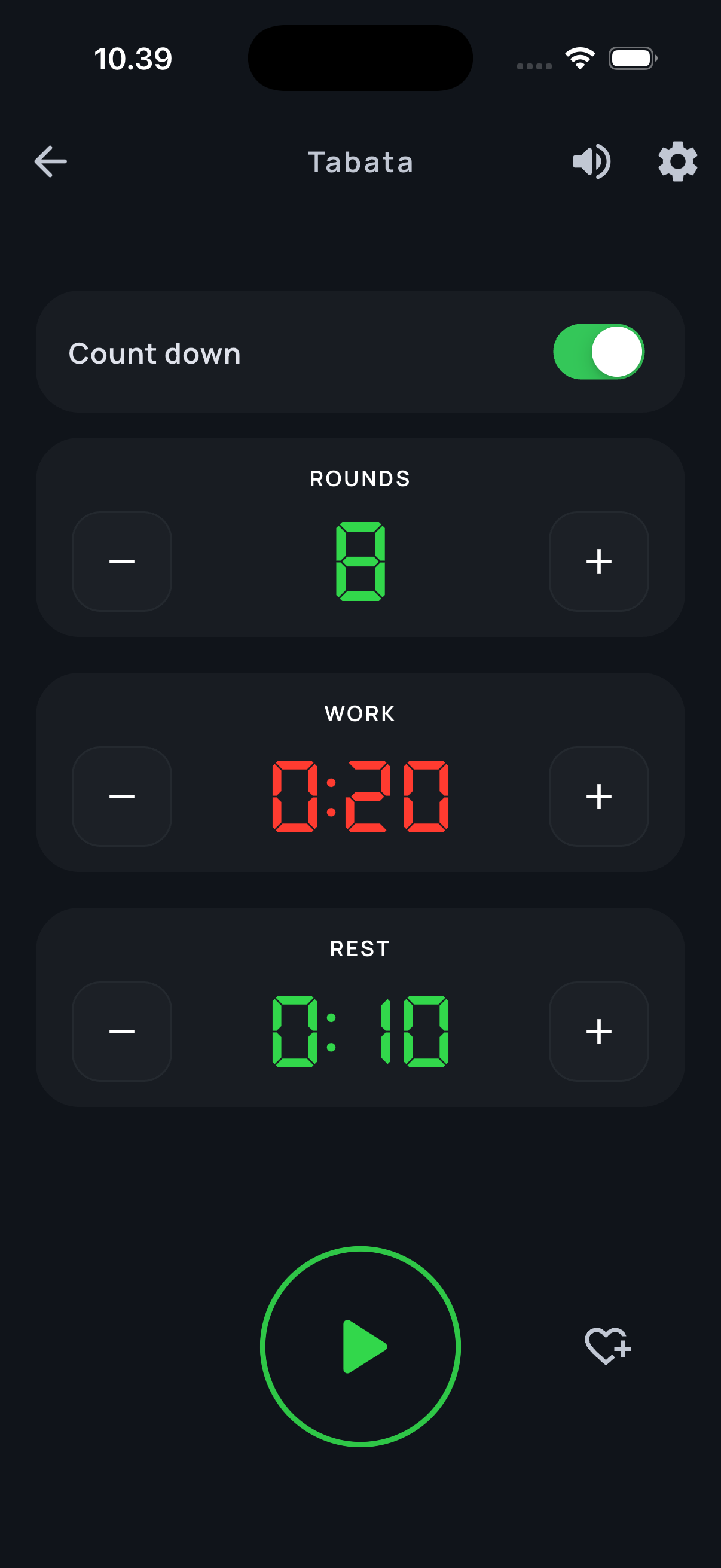
How to set up a Tabata timer in Aika
- Open the Tabata timer.
- Set Rounds to 8, Work to 0:20, and Rest to 0:10.
- Check the final-rest setting. Include it for a complete 4:00 block.
- Review any preparation time, position the timer where you can follow it, and start.
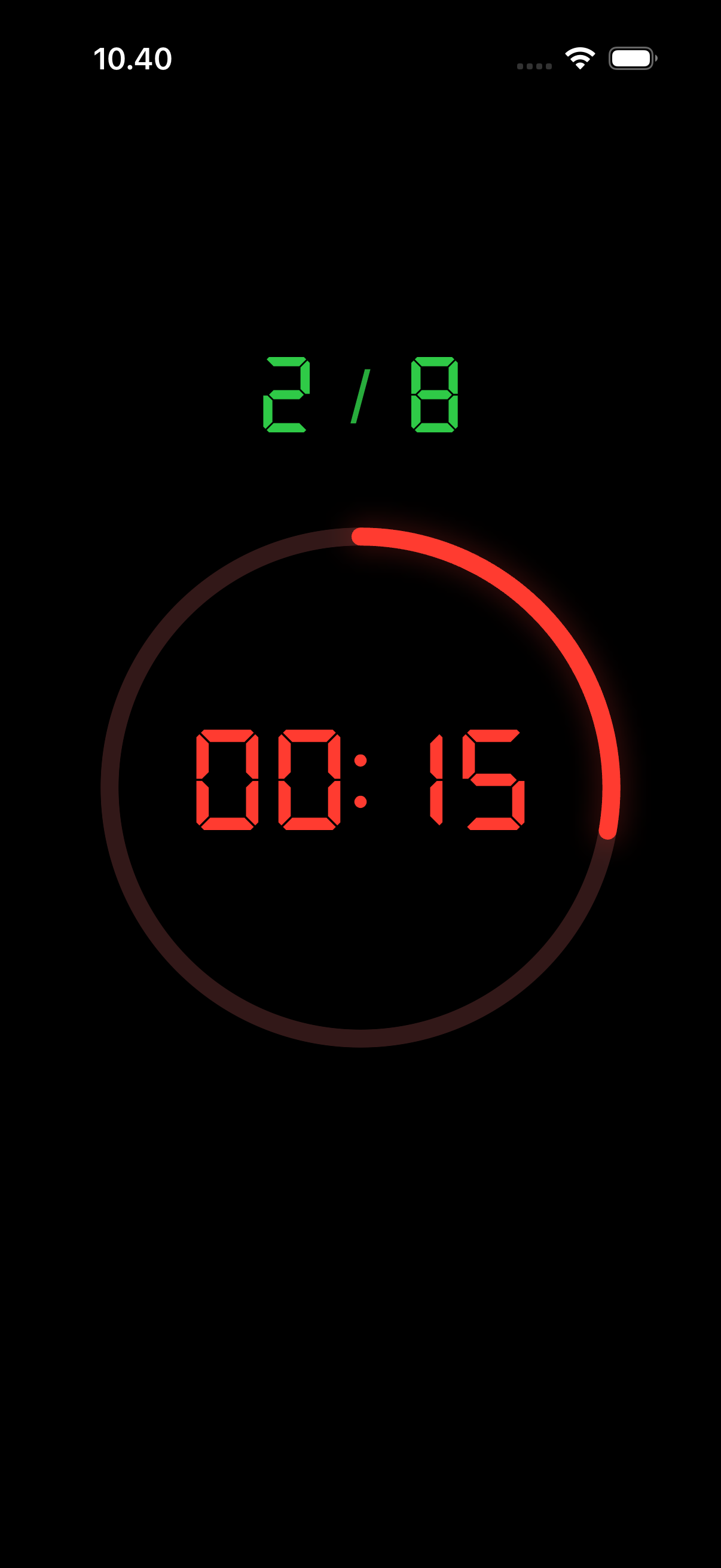
Let the timer alternate work and rest automatically. You do not need to restart it after each 20-second effort. Keep any longer recovery between blocks separate from the ten-second rests inside a block.
For a session with continuous work and self-managed breaks, compare AMRAP timing. For recurring starts with a flexible amount of rest inside each minute, use an EMOM timer.
Common questions
Is Tabata always four minutes?
Eight complete 20-second work and 10-second rest cycles total four minutes. The last work interval ends at 3:50. A timer that leaves out the final rest will finish there instead. Preparation time or extra blocks make the overall session longer.
What is the difference between Tabata and HIIT?
HIIT is a broad category of high-intensity interval training. Tabata refers to a specific protocol, while Tabata-style classes often borrow its 20/10 timing. Other interval lengths can also be used for HIIT.
Can beginners use a Tabata timer?
You can learn the timing at a comfortable effort using a familiar movement. That is a 20/10 interval practice session, not an attempt to reproduce the exhaustive research protocol. If 10 seconds is too little recovery, choose a custom interval with more rest.
Do I need eight different exercises?
No. You can repeat one movement for all eight intervals. Changing exercises adds transitions to a short rest window, so keep the setup simple and decide the sequence before you start.