Workout guides Kettlebell RPM
Kettlebell RPM Explained: How to Calculate and Hold Your Rep Pace
In kettlebell sport, RPM means repetitions per minute. At 8 RPM, you aim for eight reps each minute: one start every 7.5 seconds at an even pace. Divide 60 by your RPM to find the seconds between starts, then use the set duration to calculate your target reps.
What does RPM mean in kettlebell sport?
RPM, or repetitions per minute, describes the rate of a set. Ten RPM means ten repetitions per minute: one rep start every six seconds at an even pace.
You can use this rate for kettlebell long cycle, jerk or snatch. Read the movement and counting instructions alongside it: a complete long cycle rep includes the clean and jerk. For a double-kettlebell lift, count the prescribed repetition, rather than treating each bell as a separate rep.
A target rate also needs a load and a duration. Steve Cotter’s kettlebell training overview describes these together, with different pacing for longer sets, repeated sets and short intervals.
Source: Steve Cotter / Human Kinetics: Kettlebell sport training styles.
Average RPM and even spacing are slightly different ideas. Forty reps in five minutes averages 8 RPM, even if you start quickly and slow down. Starting once every 7.5 seconds spreads those forty target reps evenly across the set.
How to calculate seconds per rep
Seconds per rep = 60 ÷ RPM. For an evenly paced set, this is the time from the start of one rep to the start of the next. To convert back, use RPM = 60 ÷ seconds per rep.
| RPM | Seconds / rep | Reps / 5 min |
|---|---|---|
| 5 | 12 s | 25 |
| 6 | 10 s | 30 |
| 7 | ≈ 8.57 s | 35 |
| 8 | 7.5 s | 40 |
| 9 | ≈ 6.67 s | 45 |
| 10 | 6 s | 50 |
| 12 | 5 s | 60 |
Need another pace or duration? Use the RPM to seconds per rep calculator to calculate and share your target.
Training at 8 RPM? Start one rep every 7.5 seconds. Over five minutes, that gives a target of 40 repetitions. The movement and any time between reps both belong inside each 7.5-second interval.
Ready to try that schedule? Set up 5:00 at 8 RPM in Aika’s Rep Pace timer.
For a whole number of minutes, multiply RPM by minutes: four minutes at 7 RPM gives 28 target reps. For other durations, calculate duration in seconds ÷ seconds per rep. Aika counts only full rep intervals toward the target; a partial interval at the end does not add another target rep.
Keep repeating decimals in mind. Seven RPM is approximately 8.57 seconds per rep, not exactly 8.5 or 8.6 seconds. Entering the original RPM in a timer avoids changing the rate just to fit a rounded conversion.
How to maintain a consistent kettlebell rep pace
Decide what the cue means before starting. In this guide, it marks the start of a repetition. Use the same point in your movement each time. Treating one cue as a start and the next as an overhead finish makes the spacing difficult to follow.
- Choose the rhythm from your session plan. Include the movement, kettlebell load, target RPM and set duration. RPM alone is not a complete workout.
- Practice a few intervals. Check that the full movement fits without shortening its range or rushing the reset.
- Follow the early cues too. If you finish a rep quickly, wait for the next planned start instead of banking extra reps in the opening minute.
- Keep breathing and technique in the plan. The cue schedules the rep; it does not prescribe a breathing pattern or replace the movement instruction.
- Compare the target with the result. After the set, note actual reps, load and whether the later intervals stayed controlled.
If you repeatedly reach a cue before you are ready, reconsider the rate, load or duration. Trying to catch up by squeezing two repetitions into the next interval changes the even pacing you were practicing. Pause or stop the practice set when you need to reset.
A visible clock can provide reference points, but checking it on every rep can become distracting. A sound cue supplies the next start without requiring constant screen checks. Try the cue at your training volume before relying on it for a full set.
Three example kettlebell RPM sessions
These are timing examples, not a training program or recommended performance targets. Use a familiar movement and a load, rate and duration appropriate to your own session.
Long cycle: 5 minutes at 8 RPM
Interval: 7.5 seconds. Target: 40 reps.
Begin one complete clean-and-jerk repetition on each cue. Starts are 0:00, 0:07.5, 0:15 and so on. The fortieth starts at 4:52.5; its interval finishes at 5:00. Do not add a forty-first rep at the end signal.
Jerk: 3 minutes at 10 RPM
Interval: 6 seconds. Target: 30 reps.
The starts follow 0:00, 0:06, 0:12 and so on through 2:54. This example keeps one rate throughout the set. Any recovery before another set is separate from these three minutes.
Short rhythm practice: 2 minutes at 6 RPM
Interval: 10 seconds. Target: 12 reps.
Use a movement you already know to learn the start cues. If you use snatches, specify the hand-change plan separately; the rep schedule does not decide when to switch hands.
Rep pace is different from strength-training tempo
RPM describes the rate across repetitions. Tempo notation such as 3-1-X-1 describes the phases within a repetition: lowering, the following pause, lifting, then the following pause in the convention used here. It does not directly specify an RPM, and X is not a fixed number of seconds.
Two sets can have the same RPM while using different movement speeds and pauses. A rep-start cue does not tell you to lower for three seconds or hold for one. For those instructions, read how to read tempo in strength training.
How to use an RPM timer in Aika
Aika’s Rep Pace timer lets you enter the rate in RPM or seconds per rep and choose a duration or rep target. For the long cycle example, open Rep Pace, choose Duration → 5:00, then set Pace → 8 RPM. Check that the calculated target is 40 reps, review your preparation countdown and start.
The running screen keeps the countdown to the next target rep prominent, with scheduled rep progress above and total remaining work time below. This capture follows the same 8 RPM, 40-rep example.
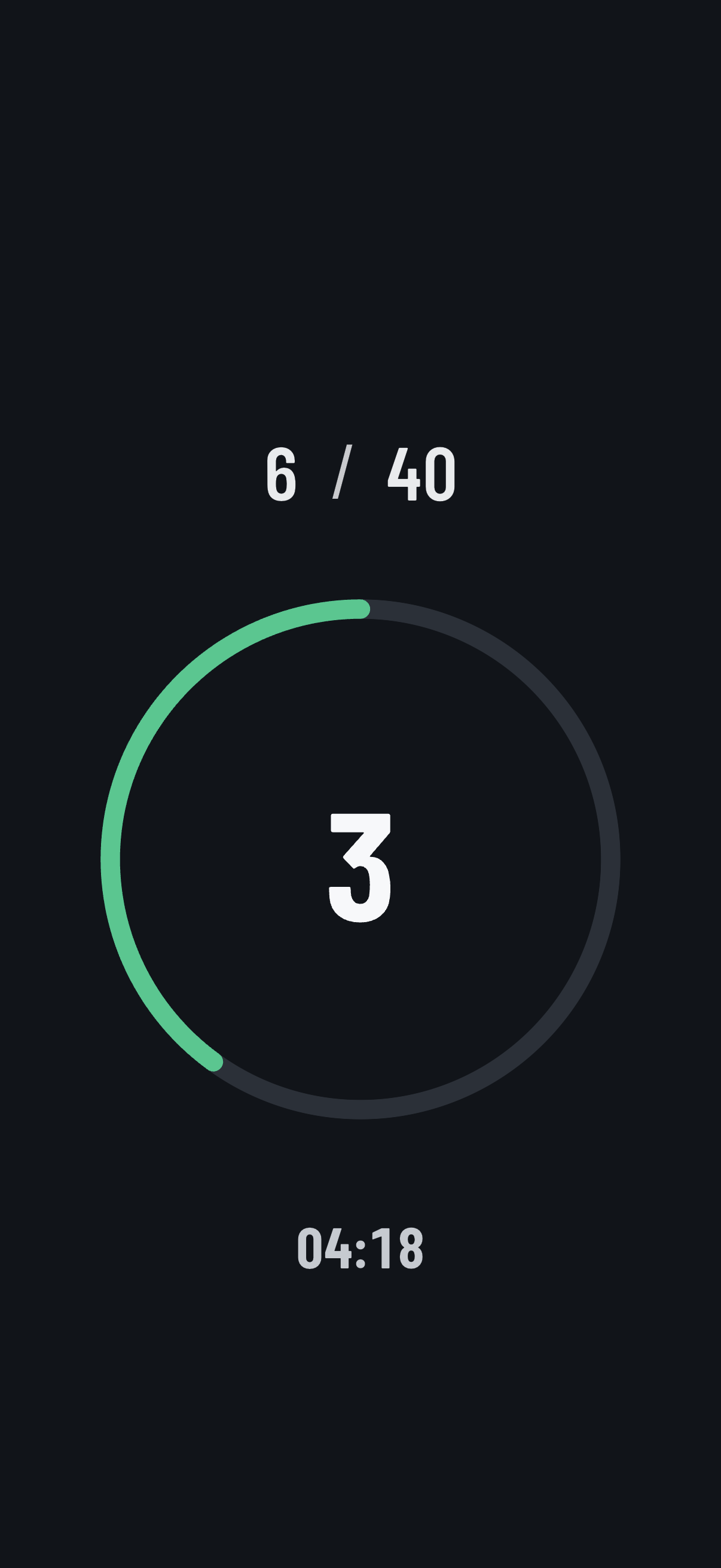
The target display is a schedule, not a completed-rep counter. Aika does not detect whether you lifted or whether a repetition met the movement standard. Keep your actual count separately. Follow the Rep Pace setup guide for both goal modes, or see one rep every 5, 10 or 15 seconds for timed singles.
Common questions
What is a good RPM for kettlebell long cycle?
There is no single right RPM. The movement, kettlebell load, set duration, experience and purpose of the session all matter. Use a pace from your training plan that you can sustain with the intended technique; the values in this guide demonstrate timing, not performance standards.
How many seconds per rep is 7 RPM?
60 ÷ 7 is approximately 8.57 seconds between rep starts. Four minutes at 7 RPM gives 28 target reps; five minutes gives 35. In Aika, enter 7 RPM directly so the timer keeps that rate instead of using a rounded seconds-per-rep value.
Do I need a metronome to keep kettlebell pace?
No. You can use a visible clock, a metronome or a rep pace timer. If you use a metronome, decide how its beats map to a rep: one beat per rep is only one possible setup. A dedicated rep pace timer also lets you set the workout duration or a target rep count.
Is RPM the same as BPM?
RPM counts repetitions per minute; BPM counts beats per minute. A 60 BPM metronome does not mean 60 reps per minute unless you deliberately do one rep on every beat. For example, one rep every ten beats at 60 BPM is 6 RPM.
Does an RPM timer count completed kettlebell reps?
Aika’s Rep Pace schedules target rep starts. Its rep display follows that schedule and does not detect movement, judge technique or verify completed reps. Keep track of your actual result separately. See the Rep Pace controls.